
Have a question? Contact us
Fill out the form and we will provide an answer or consultation as soon as possible.

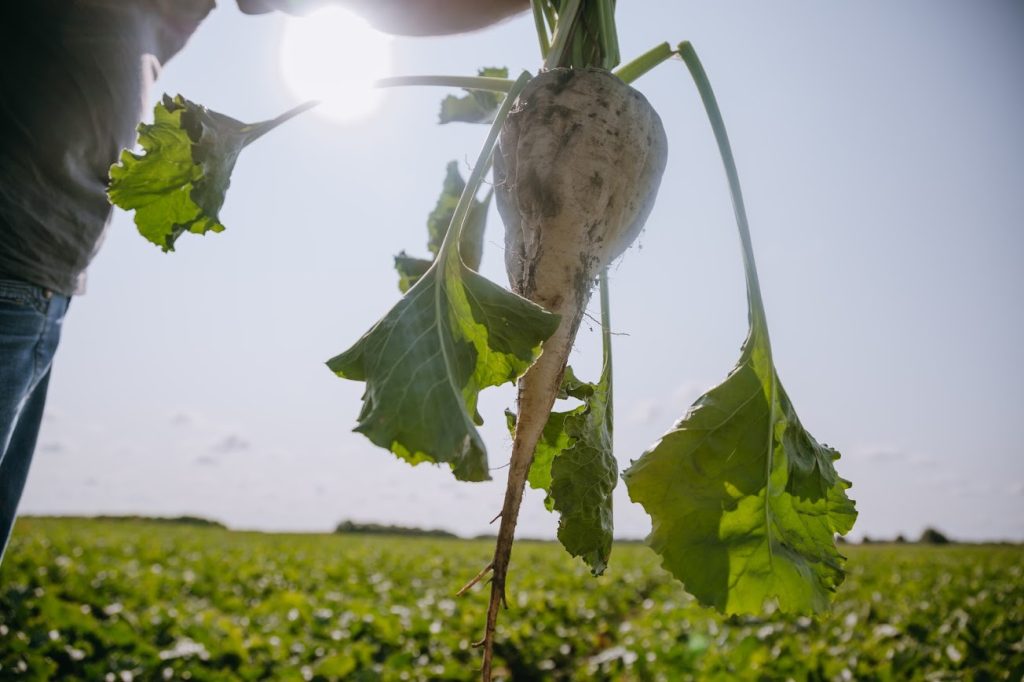
Recently, the Chairwoman of the Board of the Ukrainian Sugar Association “Ukrsugar” Yana Kavushevska, reported that more than 3,000 hectares of sugar beet crops damaged by dust storms in the west and southwest of the country will need to be replanted. Another approximately 15% of the planted area remains at risk due to frost.
And this comes against the backdrop of an overall decline in planted acreage. While Ukraine’s Ministry of Economy estimates the area at 197,000 hectares, Ukrtsukor expects a significantly lower figure — around 160,000 hectares. This could become the lowest показатель since at least the association’s establishment in 1997, and effectively the lowest in the history of independent Ukraine.
What does this mean for the market? How is the economics of sugar beet production changing? How many sugar plants may not restart this season, and what will processing margins look like? These were the topics we discussed with Yana Kavushevska. After returning from the international sugar conference in Geneva, she also shared her assessment of global trends — and they appear no more optimistic than the Ukrainian outlook.
Latifundist.com: This year’s sugar beet planting campaign started within the optimal timeframe. Were there any risks at the beginning?
Yana Kavushevska: One could say that the planting campaign started on time and within the industry’s usual schedule — neither earlier nor later than normal. Initially, everything looked stable and without anomalies, but later the situation was significantly complicated by several waves of frost.
Unfortunately, we found ourselves in a situation where the farms that acted most quickly and completed sowing within the shortest timeframe were hit by several consecutive waves of frost, followed by a dust storm. Traditionally, farmers try to complete sowing as quickly as possible in order to make the most efficient use of soil moisture, which is critically important for sugar beet cultivation. However, this season such efficiency partially worked against some producers.
We expect to have a clearer understanding of the scale of replanting by the end of the week. At that point, it will be possible to properly assess the actual planted area and the potential impact of adverse weather on the harvest.
Latifundist.com: For the second consecutive year, sugar beet acreage is declining. Is it fair to say that the main reason is lower profitability compared to other crops?
Yana Kavushevska: Farmers always look at which crop can generate a better return per hectare with the same or lower risks.
In this context, sugar beet is quite a capital-intensive crop. Investment per hectare is substantial, while returns are spread over time. In practice, the production cycle begins in the autumn with soil preparation, and only a year later — after harvesting and processing into sugar — does the farm receive a financial result. In other words, working capital is effectively “frozen” during this period.
In addition, sugar beet requires a high level of agronomic support and constant field supervision. And this means human resources, which are currently in significant shortage across the agricultural sector.
If we look back at 2023–2024, when sugar beet acreage was increasing, this was driven by a very favorable pricing environment on the global sugar market. In addition, free trade opportunities with the EU opened up, and Ukrainian sugar entered the premium European market without restrictions. At the same time, sugar exports did not face the same logistical complications that heavily affected grain exports through ports during that period. Back then, sugar beet effectively had no serious “competition” within crop rotations.
Now the situation is different. First, the pricing environment has changed — both in Europe and on global markets. Second, other agricultural crops are demonstrating attractive margins and are increasingly becoming the priority choice for producers.
Latifundist.com: So under the current risks, farmers are choosing crops that are easier and less expensive to grow?
Yana Kavushevska: Very often, yes. If there is an opportunity to achieve a similar or better result with a crop that requires lower investment per hectare and carries fewer risks, then the choice is usually obvious. That is why some farms are shifting, in particular, toward sunflower and corn, which do not require such significant investments. And this is exactly why this year we may see a historic low in sugar beet acreage during the years of Ukraine’s independence.
For comparison, in 2022 — despite the start of the full-scale war and enormous uncertainty — around 181,000 hectares of sugar beet were planted in Ukraine, and at the time that was considered a very low figure. But this year we are seeing that the acreage will be even lower, below the 2022 level.

Latifundist.com: Is this purely a Ukrainian issue, or a global trend?
Yana Kavushevska: This is a global story. I recently returned from Europe, from the Geneva Sugar Conference, which focuses on the European sugar market. And there too, they are discussing the need to reduce sugar beet acreage in order to correct prices and return them at least to minimal profitability levels.
But overall, the situation we are seeing is not new. The sugar market is traditionally cyclical: high prices stimulate increased planting, production grows — and prices fall. Then acreage declines again and prices move upward.
Latifundist.com: It is obvious that sugar production in Ukraine will decline in the new season. What figures are we talking about?
Yana Kavushevska: If last season we produced around 1.72 million tonnes of sugar, this year we expect approximately 1.2 million tonnes. That means a decline of around 500,000 tonnes.
Latifundist.com: Will these volumes be enough for domestic demand?
Yana Kavushevska: Domestic consumption after 2022 is estimated at around 900,000 tonnes, so we will fully cover this demand. There will also remain a certain export potential, approximately up to 300,000 tonnes, of which 100,000 tonnes can be supplied to the EU within the quota and up to 200,000 tonnes to other markets, particularly the Middle East, where Ukrainian sugar is currently being actively exported.
Latifundist.com: What impact will this have on the processing industry?
Yana Kavushevska: It is clear that due to the reduction in raw material volumes, processing costs are increasing. Economies of scale work in reverse, because when factories are underloaded, the cost per unit of output rises. Therefore, even despite a sufficient sugar balance for the domestic market, we should expect product prices to increase.
Latifundist.com: How dependent are sugar plants today on tolling raw materials? Is this balance changing?
Yana Kavushevska: Overall, the industry ratio remains fairly stable: about 60% is beet grown by farms affiliated with sugar plants, while around 40% is raw material supplied by independent farmers.
However, this is an average market indicator. There are, for example, enterprises that for years have worked exclusively with farmers’ raw materials and have no own beet production.
Latifundist.com: Last year, some factories did not operate. Do you expect a further decline in the number of sugar producers?
Yana Kavushevska: Yes, the situation is already more or less clear now, because factories that do not plan to operate usually do not prepare acreage or contract beet. And farmers have no reason to sow if there will be nowhere to sell the raw materials afterward.
Last year, 27 plants operated in Ukraine; this year we expect 26. So the reduction will be minor. At the same time, we still have enterprises that have remained idle since 2022. They are being preserved as production facilities, and as far as I understand, their owners are considering restarting them in the future, but they definitely will not operate this season.
Latifundist.com: How prepared is the processing industry today for energy-related risks, and what is more critical: electricity or gas?
Yana Kavushevska: It is important to understand the specifics of sugar production. Electricity is critically important primarily during the plant startup stage. Once factories reach operating mode, they switch to their own generation and work in a so-called “island mode.” Most Ukrainian factories have already invested in powerful generators to minimize risks during startup.
Meanwhile, natural gas remains a more sensitive factor for the industry. Although some enterprises have switched to alternative fuels, particularly solid-fuel boilers, gas remains the key energy resource for most plants. Accordingly, issues related to gas prices and guaranteed physical availability of the required volumes are now at the center of attention for sugar producers.
Latifundist.com: The marketing year is still ongoing, but interim conclusions can already be drawn. What does sugar export dynamics look like this season? Have any new or unusual markets emerged?
Yana Kavushevska: As of now, Ukraine has exported around 426,000 tonnes of sugar. This is 12% lower than during the same period of the previous marketing year, but overall the pace is quite good. Recently, analysts published forecasts suggesting that by the end of the current marketing year, which ends on September 1, exports will reach 500,000 tonnes. I think this figure is quite achievable, perhaps even with some upside, although I would not like to get ahead of ourselves yet.
If we talk about something less typical, there has been a rather interesting shift in export geography. Since March, Uzbekistan has entered the TOP-3 destinations for Ukrainian sugar exports. There is a strong possibility that, based on April results, it could even become the number one market for Ukrainian sugar.
Latifundist.com: That sounds unexpected. In your opinion, what enabled this market to open up?
Yana Kavushevska: It is indeed an unusual situation. In recent years, the main suppliers of sugar to Central Asian markets — apart from Russia — were Middle Eastern sugar refineries, particularly those in the UAE. However, due to the current crisis in the Persian Gulf, this supply chain appears to have been disrupted, creating a “window of opportunity” for Ukrainian sugar.
Under current conditions, complex and expensive logistics from Ukraine — through the Black Sea, Georgia, Azerbaijan, and the Caspian region — turned out to be competitive and attractive. As a result, Uzbekistan has been among the key destinations for Ukrainian sugar exports for two consecutive months.
Latifundist.com: Is this just a situational “window of opportunity,” or does Uzbekistan have the potential to become a stable market for Ukrainian sugar?
Yana Kavushevska: For now, it is more of a reaction to changes in logistics and market conditions. But importantly, this market is not new for us. In previous years — if I am not mistaken, until 2019 — Ukraine actively supplied sugar to Uzbekistan. There is a certain “market memory,” and this helps restore trade more quickly. We are currently seeing rather active and interested demand from their side.
Although unfortunately, we are also facing certain logistical constraints — transshipment capacity, availability of railcars, and so on — which slow exports and reduce the competitiveness of Ukrainian sugar in the region.
At the same time, we continue to actively export to our “traditional” markets: Middle Eastern countries, particularly Syria and Lebanon, continue importing Ukrainian sugar despite all the difficulties.

Latifundist.com: Earlier in our conversation, you mentioned that you had just returned from Europe. What is the current mood in the European sugar industry? What are market participants discussing and what solutions are being considered?
Yana Kavushevska: As I mentioned, I recently returned from the Geneva Sugar Conference. It is one of the two major global events for the sugar industry — the other one takes place in Dubai and is more global in focus, whereas the Geneva conference is centered on Europe.
Frankly speaking, the mood there is rather depressed. The European market is currently in a difficult situation: sugar prices are hovering around breakeven levels for local producers. Therefore, the main issue Europe is now focused on is how to rebalance the market.
The simplest solution, which is already effectively being implemented, is to reduce sugar beet acreage. In some cases, farmers are even being compensated to withdraw from planting contracts. In this way, the European sugar sector is self-regulating, because the lower the sugar supply on the market, the higher the price will be. There is therefore an expectation that, as a result of acreage reductions, European sugar prices will increase within the next few months. European producers openly state that the level allowing them to operate with acceptable margins is around €650/t and above.
Whether these production cuts will actually achieve that price level remains an open question.
Of course, participants’ optimism was also undermined by the situation with fertilizer and fuel prices, which will undoubtedly have a significant impact on production costs this year.
Latifundist.com: Previously, Ukrainian sugar was heavily criticized in the EU. Is this topic still being raised?
Yana Kavushevska: I would say that this rhetoric has noticeably weakened. At the previous two Geneva conferences, Ukrainian sugar was often described as one of the key destabilizing factors for the European market. This time, fortunately, such assessments were absent.
This is probably linked to the fact that there is now a clear understanding of the volumes of Ukrainian exports within the EU quota framework. In addition, Ukrainian sugar is currently being supplied in small, evenly distributed batches, which do not create sharp price fluctuations on EU domestic markets.
Instead, the main discussion focused on the IPR (Inward Processing Relief) mechanism. This is a regime that allows duty-free imports of sugar into the EU for further processing — for example into confectionery products or beverages — followed by re-export outside the European Union. Formally, these volumes do not enter the EU domestic market and are not included in its balance sheet; however, European beet sugar and sugar beet producers believe that the scale of such imports has become too significant and is creating market imbalances.
As a result, they are insisting on temporary restrictions or a revision of the regime. There are signals that the European Commission may take these concerns into account and is considering postponing the IPR mechanism until the sugar market stabilizes.
At the same time, the situation is complicated by internal industry tensions. On one side are beet sugar producers advocating for restrictions on IPR. On the other are European refineries, for which this mechanism is critically important, as their business model largely depends on raw materials imported under IPR. For them, restrictions could mean loss of profitability and even plant closures, so they emphasize their role in creating jobs and supporting the EU’s export-oriented food industry.
As a result, the European market is currently balancing competing interests: on the one hand, sugar beet acreage has already been reduced; on the other, although the issue of regulating imports through IPR remains unresolved, most market expectations suggest that some temporary decision — in the form of restrictions or postponement — will eventually be adopted.

Fill out the form and we will provide an answer or consultation as soon as possible.